Into the Horizon: A Field Guide to Black Holes

Updated: 5 days ago
In 1971, Paul Murdin and Louise Webster made a groundbreaking discovery; they were the first to identify a black hole, which had already been detected but not yet classified. Their analysis has led to the identification of many other black holes and, later in 2019, to their capture as images. But what is a black hole(BH)?
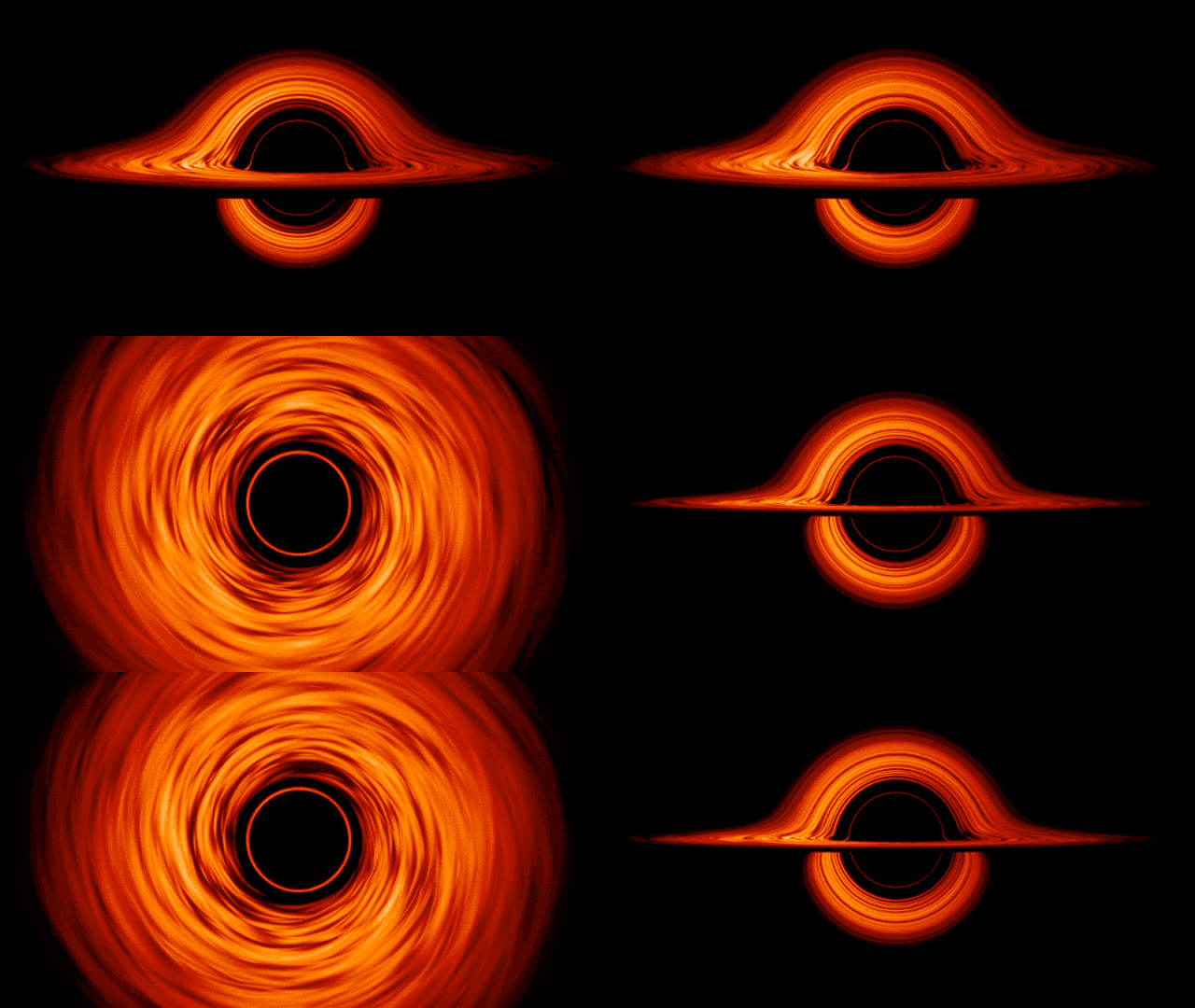
Image credit: NASA’s Goddard Space Flight Center/Jeremy Schnittman
Concept
With huge densities, great mass concentrated in a tiny region, black holes have extreme gravity to a point that nothing, not even light, can escape them, its gravity taking over any other possible forces. As light can't escape its boundary, called the event horizon (the point where gravity overcomes everything, so nothing past it can escape), the BH is considered to be invisible.
Types
Depending on its size, BHs can be considered to be of different types: stellar mass, supermassive, or intermediate. The most common ones are stellar-mass black holes, which form from the death of large stars that run out of fuel and are unable to continue nuclear fusion (which provides a force that counteracts gravity, preventing the star from collapsing in on itself). Supermassive Black Holes (SMBH) aren't the most common, but they are present at the center of nearly every galaxy, including our own. Their origin remains a mystery, as they're too massive (100k to billions of times the mass of our Sun) to have formed from a single star. Intermediate BHs are even less well known, as we have seen few; their masses range from 100 to 10k times that of the Sun, placing them between the previous types, with size being the only currently available information.
Observing BHs
Since BHs are considered invisible, since light can't escape the event horizon, scientists began observing them indirectly, through orbiting bodies, gas, and matter. Due to the intense gravity of the BH, matter pulled by it reaches such high velocities that it becomes heated and emits radiation, allowing us to detect it with telescopes. Another way of “seeing” BHs is to notice unusual behaviours in stars around regions of space that appear empty but actually contain black holes. We now have many methods for detecting such interesting bodies; these analyses are only a few examples.
Other facts
Black Holes are determined by only two quantities, their mass and the speed at which they spin. Their mass is related to how compact they become, since their huge mass is ‘held’ in such a small space, thereby increasing their gravitational force. It is also related to the fact that the smaller it is, the faster it spins. Even with its powerful gravitational pull, it doesn't behave like an uncontrolled vacuum, consuming anything that passes by; bodies orbit it and normally fall in only under external perturbations. Black holes are messy eaters, as most of what falls into them is ejected outwards because the object is being ripped apart, so matter can be flung off in the process. What is then jetted away, commonly called “winds”, has either a positive or a negative effect on star formation, playing a significant role in a galaxy's lifespan.


Comments